Location >>
 Technology Spotlight | Containerized Biogas Systems
Date:2026-06-30
As ASEAN continues to advance its renewable energy transition, biogas is playing an increasingly important role in turning organic waste into valuable energy.
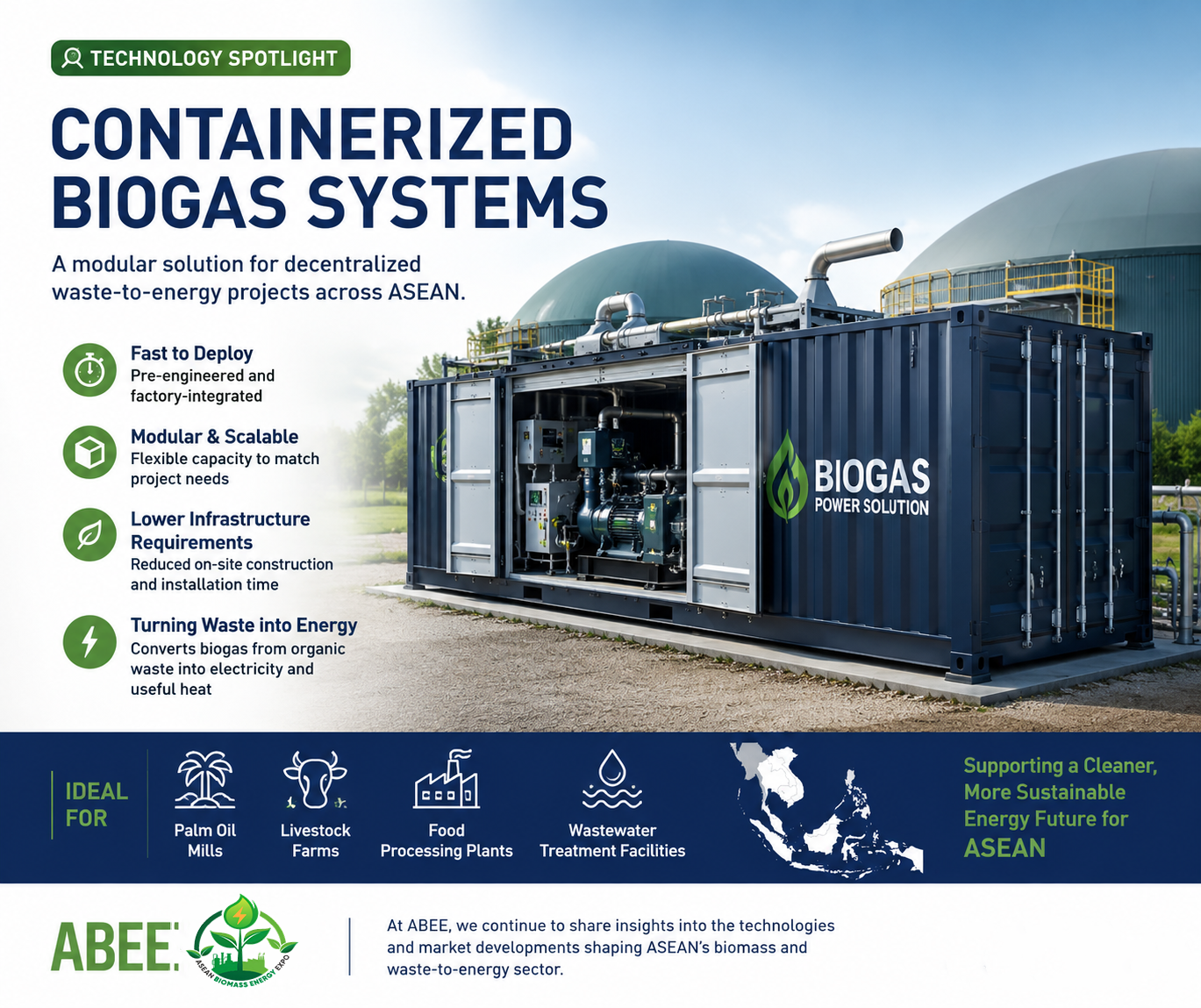
Among the technologies supporting this shift, containerized biogas systems offer a flexible and efficient solution for on-site power generation.
So, what exactly is a containerized biogas system?
Contrary to what the name may suggest, it doesn't produce biogas.
Instead, biogas generated from livestock manure, food waste, agricultural residues or palm oil mill effluent (POME) is:
- Cleaned and treated
- Converted into electricity and useful heat
- Managed through equipment integrated inside a standard shipping container
Why is this approach gaining traction?
Its key advantages include:
• Fast deployment
• Modular and scalable design
• Lower infrastructure requirements
• Suitable for decentralized energy projects
These systems are particularly well suited for palm oil mills, livestock farms, food processing plants and wastewater treatment facilities.
What does this mean for ASEAN?
Across Malaysia, Indonesia, Thailand and Vietnam, biogas is already helping reduce methane emissions, improve waste management and generate renewable energy.
Containerized systems provide another practical option for organizations looking to deploy scalable, decentralized waste-to-energy solutions.
As ASEAN continues to unlock the value of biomass and organic waste, technologies like these are expected to play an increasingly important role in the region's clean energy transition.
At ABEE, we'll continue to spotlight technologies, market trends and real-world applications shaping the future of biomass and waste-to-energy across Southeast Asia.
ABEE—ASEAN Biomass Energy Expo 2027
Date: 17–19 March 2027
Venue: IMPACT Exhibition and Convention Centre, Bangkok, Thailand
Visitor registration: https://e.hwdl.vip/?rr